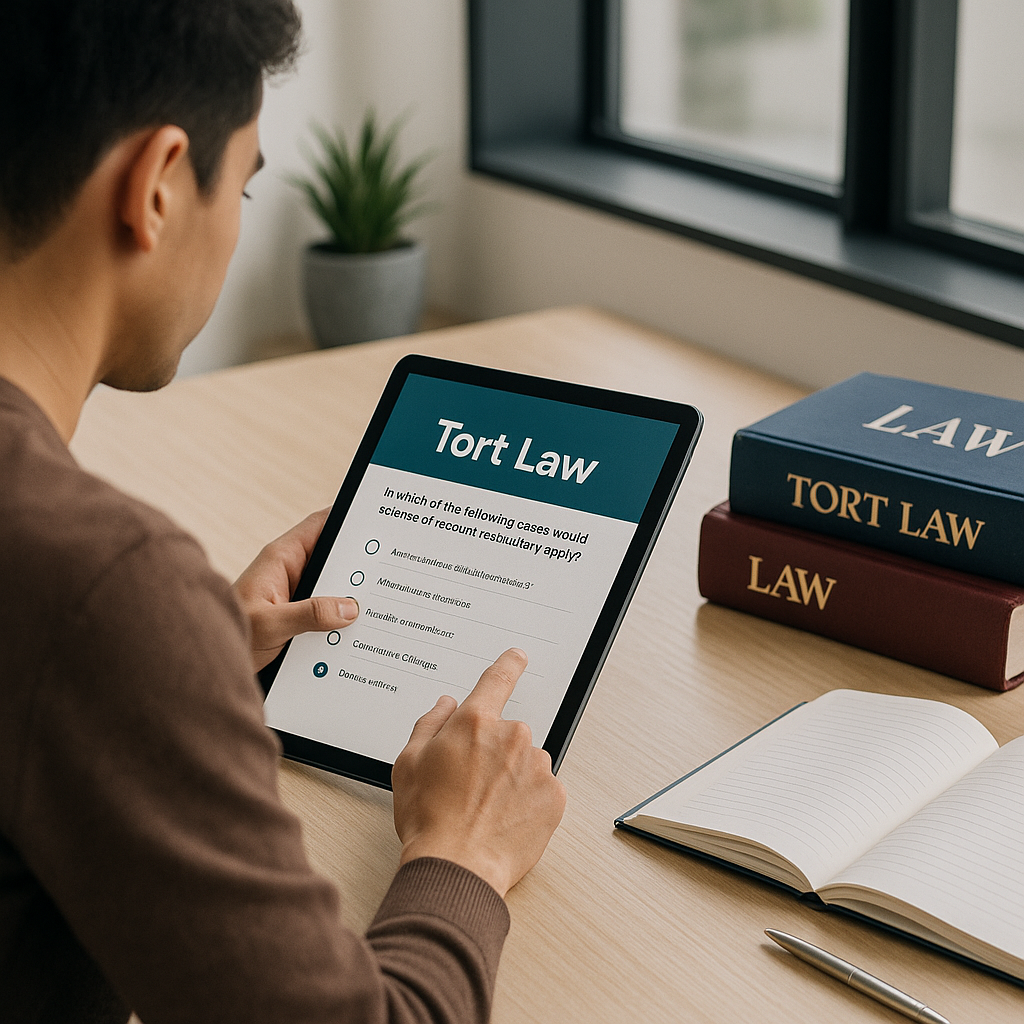
Tort Law MCQs Are Tough—Here’s How to Nail Them
Tort law questions on the SQE1 exam catch a lot of candidates off guard. Why? Because they often blend legal principles with tricky fact patterns, and the distractor answers aren’t obvious. If you’re scoring below 60% in tort law drills, you’re not alone. But here’s the good news: focused active practice can fix this.
Why Passive Learning Fails for SQE1
Re-reading textbooks or lecture notes might feel productive, but it’s not. SQE1 exams require application, not memorization. You don’t just need to know the principles of negligence—you need to apply them under time pressure. For example, can you quickly pinpoint the duty of care in a scenario involving an economic loss? What about identifying the correct remedy for a nuisance claim?
Here’s the brutal truth: passive learning builds familiarity, but active recall builds mastery.
The Problem with Memorization
Passive strategies, like highlighting notes or re-reading chapters, don’t engage the critical thinking skills SQE1 tests require. A study by Karpicke & Blunt (2011) found that active recall methods, such as testing yourself, are 50% more effective than passive review when it comes to long-term retention. That’s why it’s critical to prioritize methods that force you to retrieve and apply information.
An Example of Passive vs. Active Learning in Tort Law
Take the principle of negligence. A passive approach might involve re-reading a textbook chapter that outlines the three-part test established in Caparo Industries plc v Dickman: foreseeability, proximity, and whether imposing a duty is fair, just, and reasonable. But passive reading doesn’t prepare you to apply that test in an exam setting. An active approach would involve answering MCQs where you identify whether a duty exists in nuanced scenarios, like occupational accidents or professional advice leading to economic loss.
Fixing Weak Spots: The Active Practice Method
So, how do you actually improve? Start by identifying where you’re struggling. Tools like SQE1 Drills make this easy with their weak-topic detection. If your tort law scores drop below 60%, the system flags it. From there, you can set up focused drill sessions to attack those weak spots.
Step-by-Step: Targeting Tort Law Weak Spots
-
Run a Baseline Test: Start with a full drill session (60-90 questions) in Exam Mode. This mimics real SQE1 conditions: timed, no instant feedback, full focus.
- Example: If you score 55% on a negligence-heavy mock, you know this is an area to prioritize.
-
Analyze Your Results: Look at your accuracy by topic. Are you bombing negligence questions? Struggling with nuisance remedies? Pinpoint the subtopics where you’re losing marks.
- Example Subtopics:
- Duty of care in negligence cases
- Strict liability under Rylands v Fletcher
- Remedies for private nuisance
- Example Subtopics:
-
Set Up Focused Drills: On SQE1 Drills, you can configure a 30-question session just for tort law. Choose Instant Feedback mode to learn as you go.
- Tip: Focused drills help you isolate specific weaknesses. For instance, if you’re struggling with economic loss, select only negligence questions.
-
Review Explanations: Pay attention to why you got questions wrong. Did you misread the facts? Forget a key case like Donoghue v Stevenson? Misapply a principle like proximity?
- Example: If you misunderstood the application of causation, review leading cases such as Barnett v Chelsea & Kensington Hospital Management Committee.
-
Repeat Until Mastery: Keep drilling until your accuracy consistently hits 70% or higher. Then move back to full-length sessions to test retention under timed conditions.
Tools and Resources
- SQE1 Drills: Offers weak-topic analytics and customizable question banks.
- Quimbee: Provides video case briefs for understanding key tort law cases.
- Practice Flashcards: Apps like Anki allow you to drill legal principles on the go.
Real Example: Negligence Remedies
Let’s say you’re tackling a negligence question involving pure economic loss. The scenario might involve a builder giving faulty advice to a homeowner, resulting in financial damage. To answer correctly, you need to:
- Recognize that economic loss is only recoverable in limited situations.
- Apply the Caparo Industries plc v Dickman test for duty of care.
- Distinguish between consequential economic loss and pure economic loss.
Concrete Example
Scenario: A financial advisor gives negligent investment advice, causing you to lose £50,000. Do you have a claim?
- Step 1: Is there a duty of care? Under Hedley Byrne & Co Ltd v Heller & Partners Ltd, economic loss is recoverable if there’s a special relationship of reliance.
- Step 2: Was the advice breached? Analyze whether the advisor acted negligently.
- Step 3: Did the breach cause the loss? Apply factual and legal causation tests, such as the but-for test.
By practicing questions like this, you’ll learn to quickly identify the key legal principles and apply them under time pressure.
Why Weak-Topic Drills Beat Full-Length Mocks
Mock exams are helpful, but they don’t fix weak spots. If you’re consistently failing tort law questions, another mock won’t magically improve your score. You need targeted practice. SQE1 Drills’ analytics dashboard highlights your weak areas so you can focus your energy where it matters. Their case study notes that candidates who focused on weak-topic drills saw pass rates improve by 20%.
The Problem with Over-Reliance on Mocks
Mocks provide a snapshot of your performance, but they don’t diagnose the root of your mistakes. For example:
- If you consistently fail questions on vicarious liability, a mock won’t give you enough repetitions to improve.
- Drills, on the other hand, allow you to practice 20+ questions on just vicarious liability until you master it.
Common Pitfalls to Avoid
- Ignoring Weak Spots: If your tort law accuracy is below 60%, don’t waste time on Contract Law drills just because it’s easier.
- Skipping Explanations: Every wrong answer is an opportunity to learn. Use tools that provide detailed rationales, like SQE1 Drills’ AI tutor.
- Procrastinating on Practice: SQE1 isn’t forgiving. Weak areas cost you marks—and confidence. Attack them early.
FAQ
Q1: Can’t I just use a textbook for tort law prep? A: Textbooks are great for understanding theory, but they don’t teach application. SQE1 exams test how well you apply legal principles under pressure. Practice MCQs are non-negotiable.
Q2: How do I know which tort law topics to focus on? A: Use analytics tools like SQE1 Drills to track your accuracy by topic. If you’re scoring below 60% on negligence questions, that’s your cue to focus.
Q3: What’s the best way to improve accuracy in tort law MCQs? A: Run focused drill sessions in Instant Feedback mode. Review rationales for wrong answers and repeat until you hit 70%+ accuracy.
Q4: How long does it take to see improvement? A: It depends on how often you practice. With consistent daily drills, candidates typically see improvement within 2-3 weeks.
Q5: What makes SQE1 Drills different from other prep tools? A: SQE1 Drills combines AI-powered weak-topic detection with unlimited practice questions tailored to the SRA’s SQE1 specifications. It’s also just £5/month—far cheaper than traditional prep courses.
Tort Law MCQ Strategy Comparison Table
| Strategy | Pros | Cons | Best For |
|---|---|---|---|
| Textbook Reading | Good for understanding theory and basic principles | Doesn’t build application skills | Early stages of prep |
| Mock Exams | Mimics real exam conditions | Doesn’t address specific weaknesses | Testing overall readiness |
| Focused Drills | Targets weak spots, improves specific topic accuracy | Time-intensive, requires self-discipline | Addressing weak areas quickly |
Final Thoughts
Active practice isn’t just effective; it’s essential. If you’re struggling with tort law negligence remedies or nuisance claims, don’t just re-read your notes. Drill targeted questions until you can confidently apply the principles in any scenario.
Ready to fix your weak spots? SQE1 Drills offers affordable, AI-powered prep with real-time analytics and weak-topic detection. Start practicing today.
Learn more at SQE1 Drills