Why Eliminating Wrong Answers Feels Impossible in SQE1
If you've ever stared at an SQE1 multiple-choice question (MCQ), second-guessing yourself into oblivion, you're not alone. With 360 questions split across two papers, the exam isn’t just testing your legal knowledge. It’s testing how quickly and accurately you can apply it under pressure. And the hardest part? Deciding between the final two options that both seem right.
Most candidates fail here. According to the Solicitors Regulation Authority (SRA), the SQE1 pass rate hovers around 53%. That means nearly half of candidates walk out knowing they didn’t make it. So, why is eliminating wrong answers such a struggle? Distractor options. These are the ‘almost correct’ answers designed to trip you up. They prey on your insecurities, lack of focus, or gaps in knowledge.
But here’s the good news: you can train your brain to spot and eliminate these traps. Let’s break it down.
Step 1: Understand the Anatomy of a Distractor
Distractors are sneaky. They often look plausible but contain subtle flaws. Maybe they misstate a legal principle, misapply a rule, or include irrelevant facts to confuse you. For example, in a question about contract law, a distractor might reference consideration when the real issue is formation.
Here’s an approach that works: break the question into parts. Focus on the stem (the main question), and identify exactly what it’s asking you to do. Does it want the most accurate statement of law? The best course of action for your client? Or simply the answer that aligns with specific facts? This clarity is your first line of defense against distractors.
Example: A Common Trap
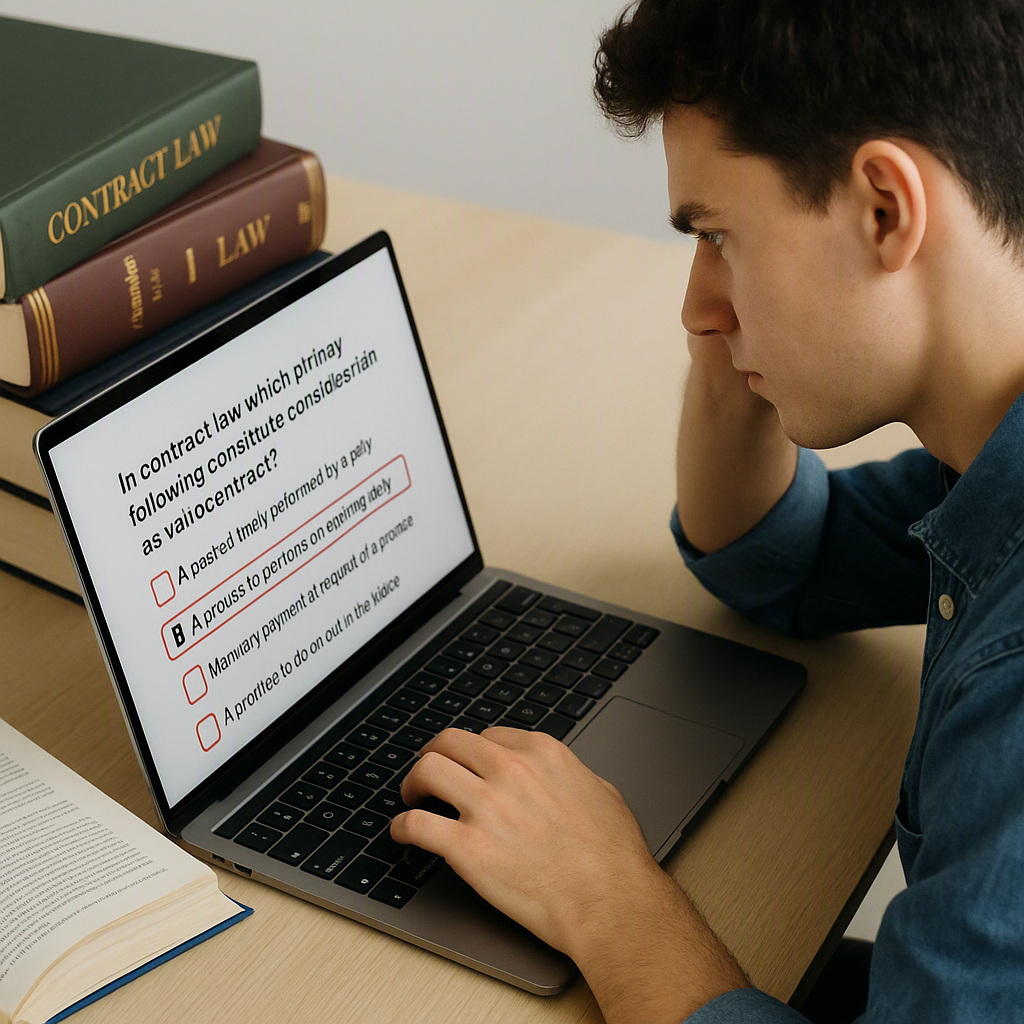
Question: Which of the following is NOT a valid consideration in an enforceable contract?
- A) A promise to refrain from doing something you’re legally permitted to do.
- B) A promise to perform an existing contractual obligation.
- C) A promise made under duress.
- D) A promise to pay a reasonable price for goods already delivered.
Answer: C. Why? Because duress invalidates the promise itself. Distractors like A or B might seem wrong at first glance, but they’re actually valid forms of consideration under certain circumstances.
Actionable Steps:
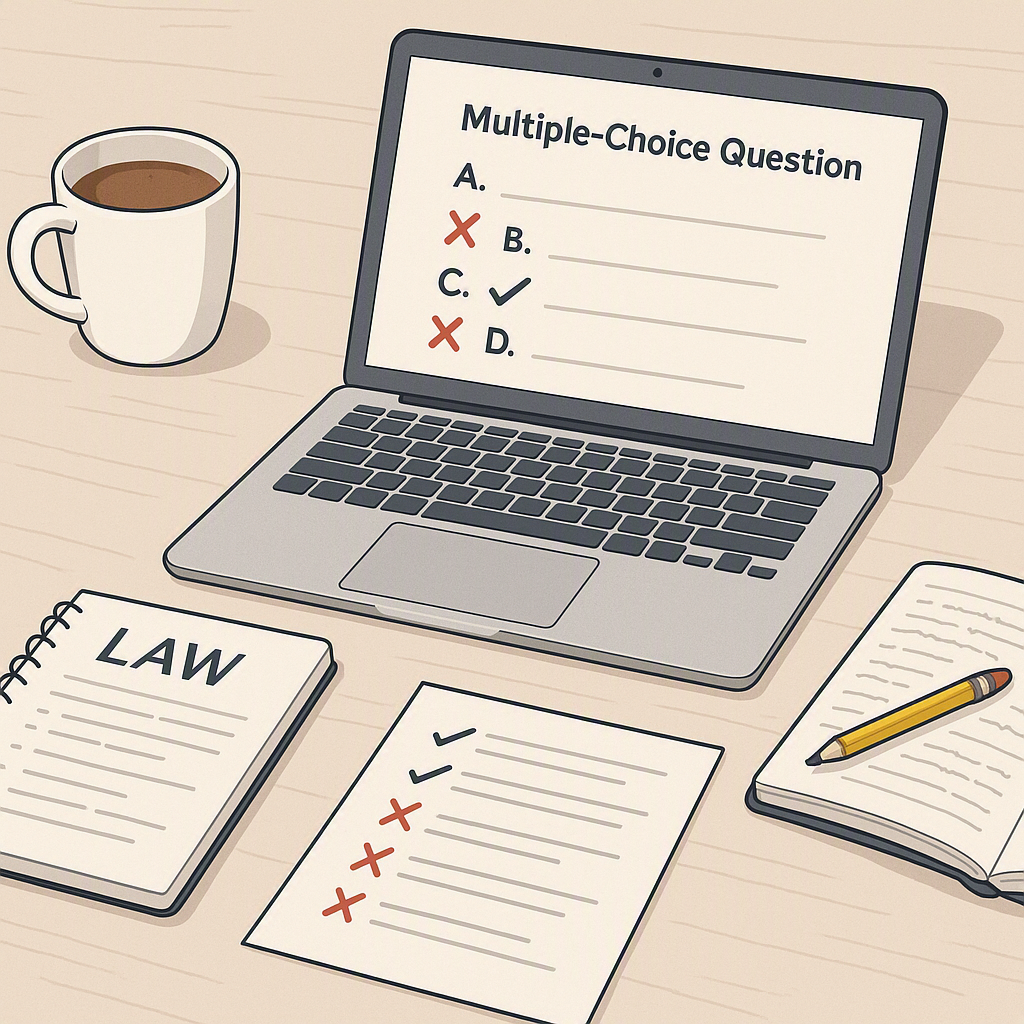
- Read the stem twice to avoid rushing into the wrong mindset.
- Highlight key words in the question (e.g., “NOT,” “valid,” “best”). The SQE1 often uses modifiers to test your attention to detail.
- Review common distractor patterns for each subject. For example, in tort law, distractors often confuse duty of care with causation.
Step 2: Drill Weak Topics Until They Stop Being Weak
Here’s a brutal truth: If you’re scoring below 60% in any subject area, you’re at risk of failing. SQE1 isn’t forgiving. Every subject matters, and bombing one can sink your overall score.
This is where weak-topic detection saves you. Tools like SQE1Prep analyze your performance across hundreds of MCQs and show you exactly where you’re struggling. For instance, let’s say you consistently miss questions on easements in Land Law. Instead of randomly revising the entire topic, you can focus all your energy on easements until your accuracy improves.
Strategies for Weak-Topic Drilling
- Categorize Your Mistakes: Were you wrong because you didn’t know the law? Or did you misapply it? Knowing why you’re wrong is the first step to fixing it.
- Use Resources That Break Down Principles: For example, if you’re struggling with trusts, use a study tool that explains the differences between resulting and constructive trusts in simple terms.
- Revisit the Same Questions Weekly: Repetition will solidify your understanding. If you got a question wrong once, reattempt it a week later to see if you’ve internalized the correct reasoning.
Key Tip:
Don’t just memorize the “correct” answer. Understand why the distractors are incorrect. This habit trains you to eliminate wrong answers more effectively in future questions.
Step 3: Use Exam Simulations to Master Time Pressure
Guess what happens when you’re short on time? You panic. And panicked decisions are often wrong. SQE1’s timed format is unforgiving, with 180 questions per paper and no room for hesitation.
Practicing under exam conditions is non-negotiable. That’s why we built an Exam Mode into SQE1Prep. It replicates the real SQE1 format: no breaks, no pauses, just you, the clock, and 180 questions. This isn’t just about building stamina—it’s about learning to eliminate wrong answers quickly and confidently. The more you simulate this pressure, the better you’ll perform on exam day.
How to Simulate Exam Conditions Effectively
- Set a Timer: Allocate just over 1 minute per question (135 minutes for 120 questions).
- Don’t Skip Questions: In the real exam, you can’t come back to a question once you’ve moved on. Practice making decisions quickly but thoughtfully.
- Analyze Your Timing: After each simulation, review where you spent the most time. Was it on a specific subject? A particular question type?
Step 4: Always Review Explanations—Even for Correct Answers
One of the most common mistakes candidates make is skipping question reviews. Got it right? Great, move on—right? Wrong.
Many questions are designed to test multiple layers of knowledge. You might pick the correct answer for the wrong reason, which means you’ve learned nothing for next time. SQE1Prep’s AI Tutor explains why each answer choice is right or wrong, breaking down the legal principles behind every question. For example, it might clarify why a specific statute applies or why a case law precedent invalidates an option. This kind of immediate feedback is invaluable.
Decision Framework: How to Eliminate Distractors
| Step | Key Question to Ask | Example Application |
|---|---|---|
| Read the stem carefully | What is the question really asking? | Is it asking for an exception, or the general rule? |
| Evaluate each option | Why is this option wrong? | Check for misstatements of law or irrelevant details. |
| Cross-check facts | Does this option align with the facts provided? | Eliminate answers that contradict the scenario given. |
Common Mistakes to Avoid
- Rushing through questions: If you’re not reading the stem carefully, you’ll fall for distractors. Slow down, even in practice.
- Ignoring weak topics: Don’t assume you’ll “wing it” on exam day. The SQE1 pass mark doesn’t leave room for weak spots.
- Over-relying on memory: SQE1 is about application, not memorization. Practice applying the law to specific scenarios.
FAQ
Q: How do I know which topics I’m weak in? A: Use analytics tools like SQE1Prep to track your performance. Weak-topic detection highlights areas where you’re scoring below 60%.
Q: What’s the most effective way to study MCQs? A: Focus on active recall. Instead of passively reading notes, drill questions, review explanations, and reattempt weak areas.
Q: How can I manage time better during the exam? A: Simulate the full exam at least twice before test day. Use tools like SQE1Prep’s Exam Mode to practice pacing.
Q: What do I do if two answers seem equally correct? A: Look for subtle differences. Re-read the question stem and match the answer to the specific facts or legal principle being tested.
Q: Is it possible to pass SQE1 without a prep course? A: Technically, yes, but a structured course or tool like SQE1Prep can save you hundreds of hours by focusing your study on high-yield topics and weak areas.
Ready to Eliminate Wrong Answers?
If you’re struggling with SQE1 MCQs, SQE1Prep can help. With real-time analytics, weak-topic drills, and exam simulations, it’s the ultimate tool for mastering the exam. Get started free →
For more on eliminating distractors, check out our resource: Single best answer strategy pdf.
Learn more at SQE1 Drills